Warp Factory v1.0 (Helmerich et al. 2024, arXiv:2404.03095) is a public MATLAB toolkit for evaluating energy conditions on warp-drive metrics. It shares no code with this project's SymPy/NumPy pipeline and is maintained by an independent group. Phase 3 uses it to (i) reproduce the Fuchs et al. 2024 existence anchor independently, (ii) sweep the κ-scaling-law surface across $(M, R_2, \beta)$, and (iii) confirm the textbook Alcubierre violation as a tooling sanity check.
Environment: MATLAB R2023a Update 8 with Parallel Computing Toolbox + default toolboxes; Warp Factory cloned to F:\science-projects\WarpFactory\ (out-of-tree). All scripts and outputs in the project's warp_factory_repro/ directory.
Since Session 25, MATLAB is no longer available to the project and the working pipeline is warp_factory_py — a clean-room NumPy port of the slice of Warp Factory this repo depends on (metric builders, Christoffel/Ricci/Einstein solvers, Eulerian frame transform, energy conditions), anchored to reproduce the MATLAB results within tolerance. A handful of bugs found in the upstream source are preserved behind a wf_compat=True flag so the MATLAB-matching behaviour stays reproducible (nothing was filed upstream; the port is a private reproduction instrument, not a fork).
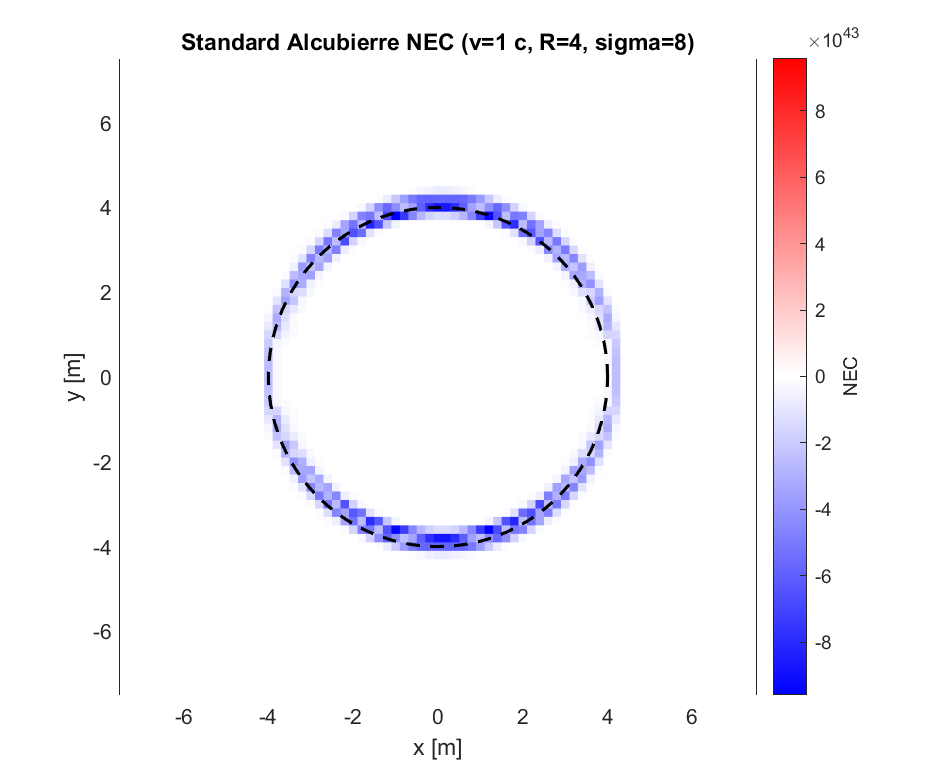
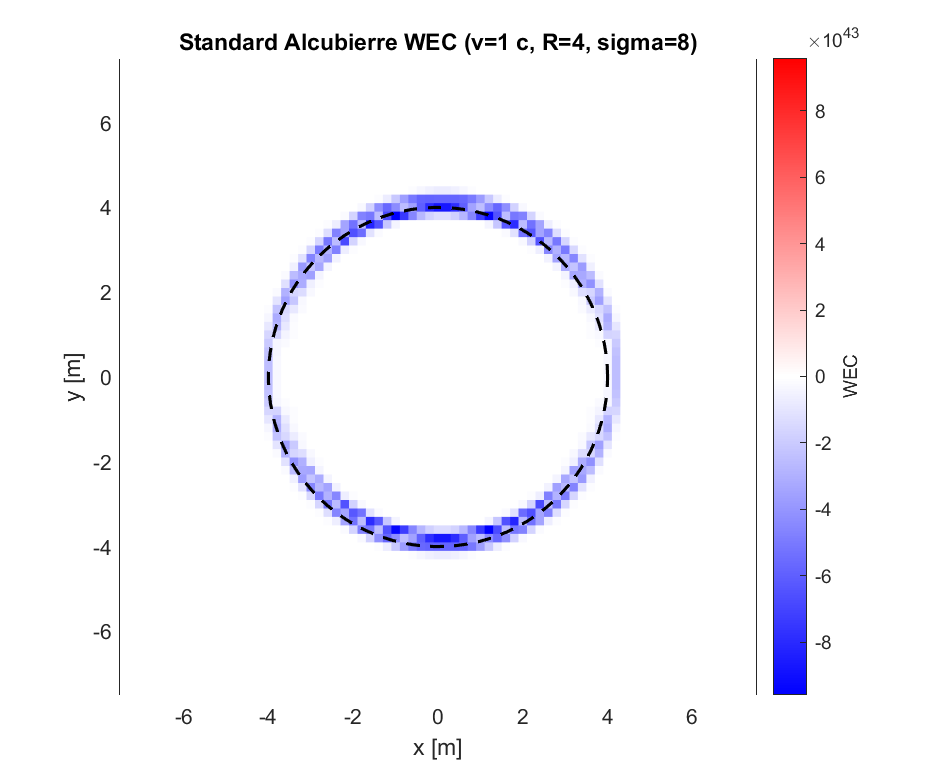
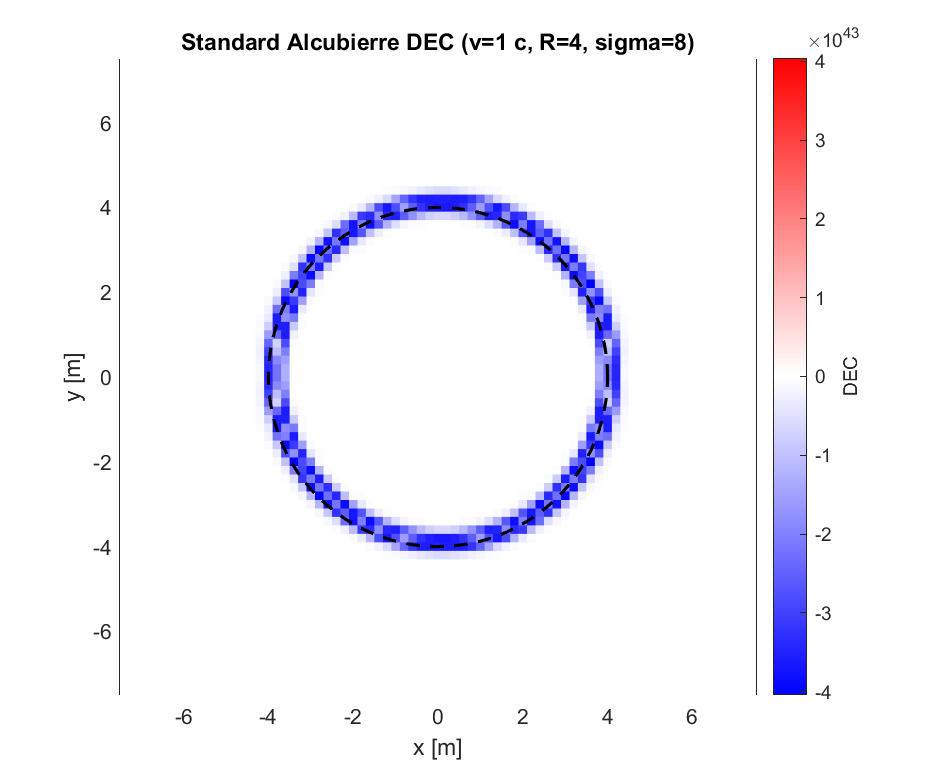
Run the standard Alcubierre metric at $(v=c, R=4\,{\rm m}, \sigma=8\,{\rm m^{-1}})$ — the Pfenning–Ford 1997 textbook configuration — and evaluate NEC, WEC, DEC, SEC pointwise on the in-mask grid:
| Energy condition | In-mask pass fraction | min value |
|---|---|---|
| NEC | 0.0737 | −9.6 × 10⁴³ |
| WEC | 0.0737 | −9.6 × 10⁴³ |
| DEC | 0.0737 | violated |
| SEC | 0.0737 | violated |
92.6% of in-mask cells violate every energy condition — matching Pfenning-Ford 1997 expectations to within numerics. The pipeline returns the textbook negative result on a known violator, so positive-EC results from Warp Factory on Fuchs-class metrics are not artefacts.
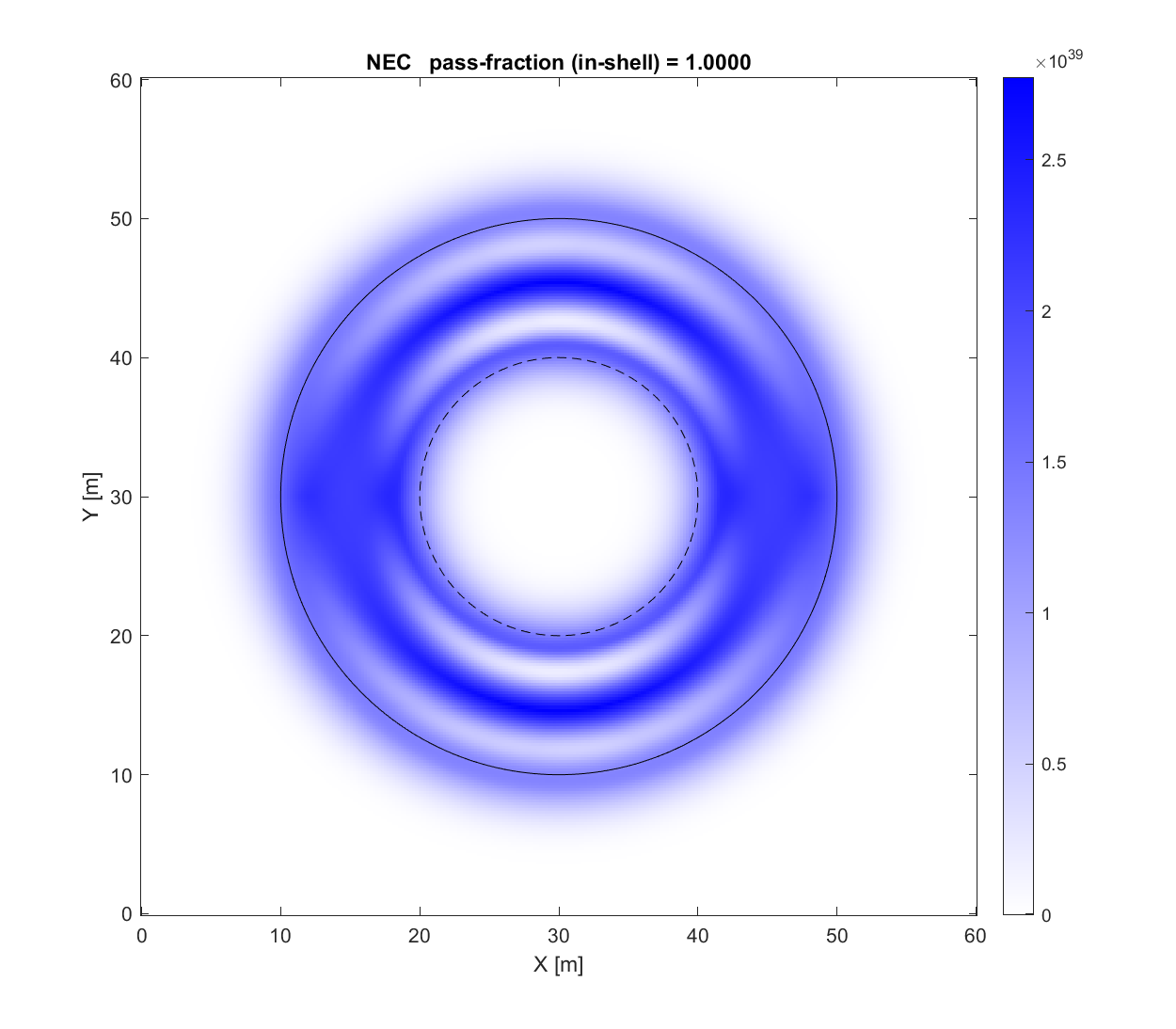
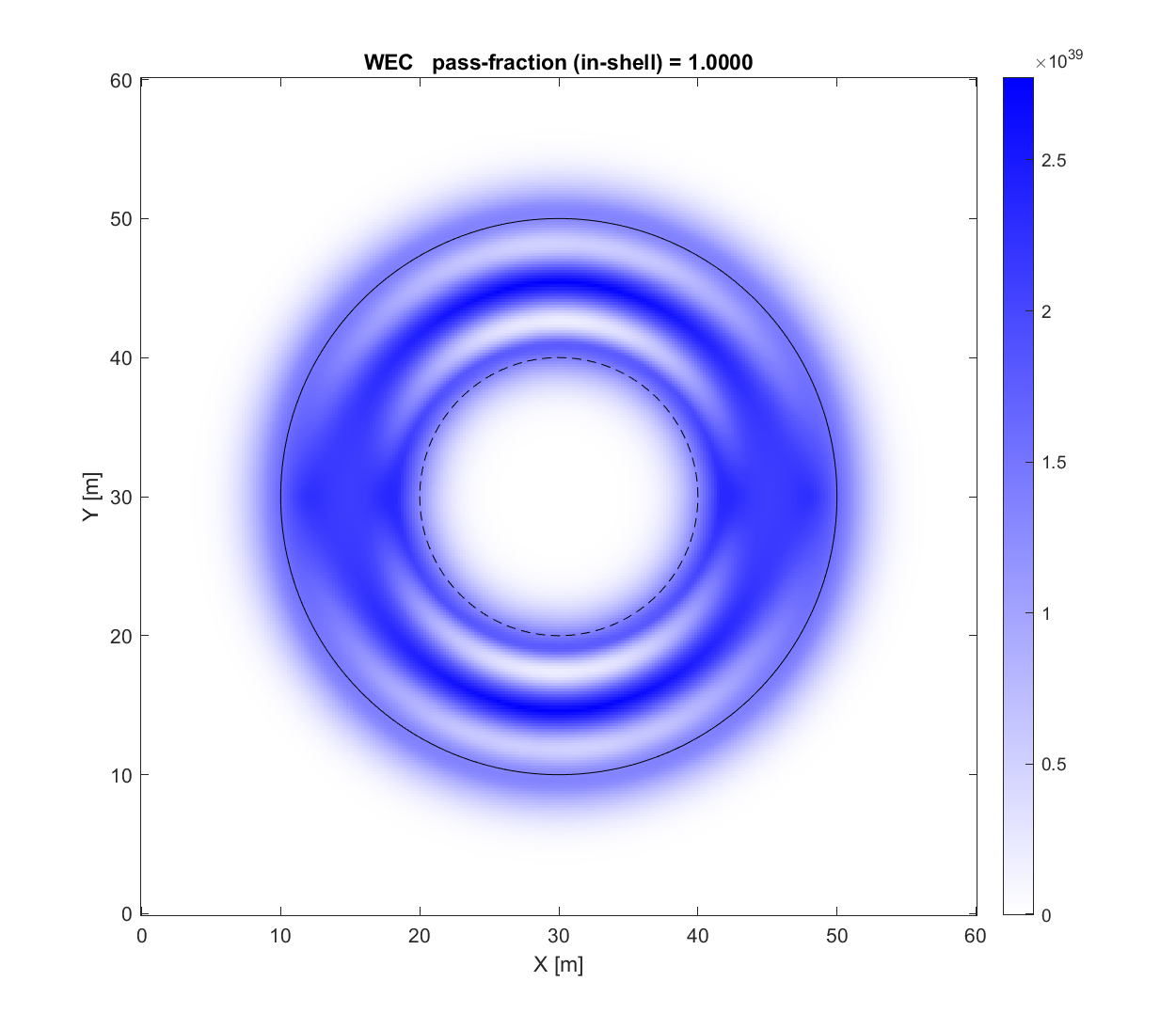
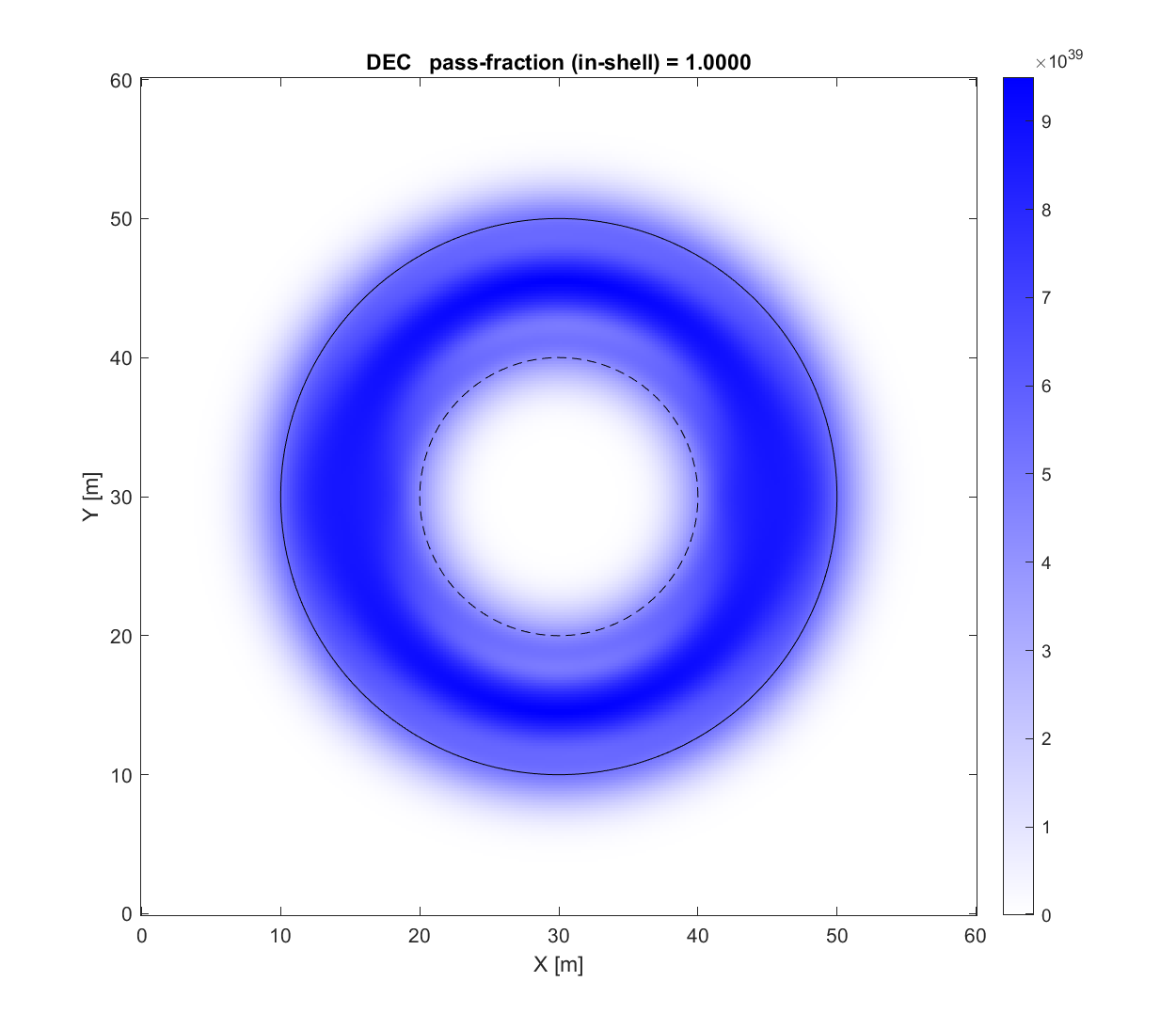
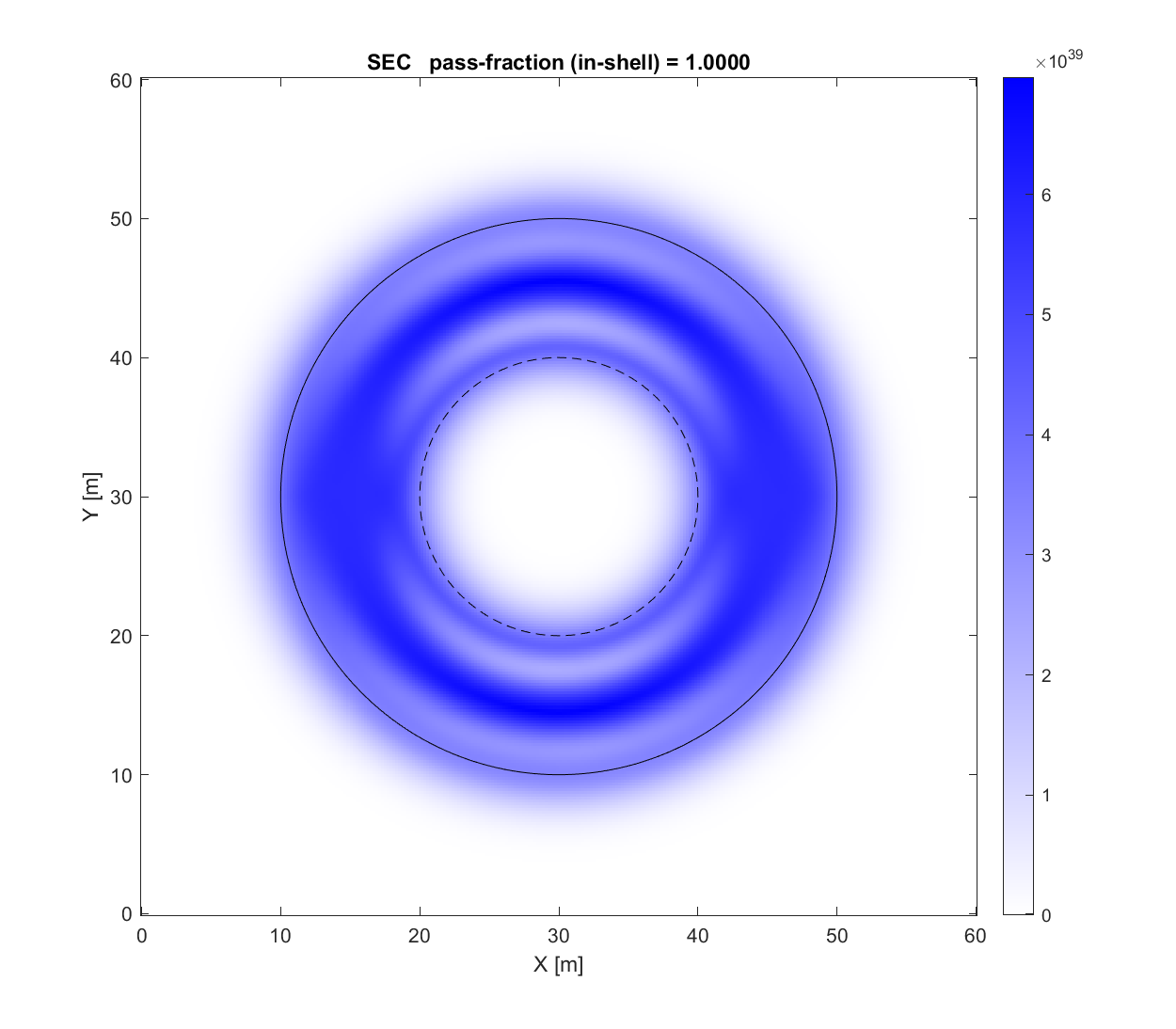
Reproduce Fuchs et al. 2024 Fig. 10 at canonical parameters $(R_1=10\,{\rm m}, R_2=20\,{\rm m}, M=4.49\times10^{27}\,{\rm kg}, \beta=0.02c)$ and bracket $\Delta_{\min}$ by holding $(M, R_2, \beta)$ fixed and sweeping the shell thickness $\Delta = R_2 - R_1$.
At the canonical point, in-shell pass fractions for all four energy conditions are identically 1.0000 — the existence claim is independently confirmed. The κ bracket:
| Δ [m] | R₁ [m] | passNEC | passWEC | passDEC | passSEC | κ = ΔC/(βR₂) |
|---|---|---|---|---|---|---|
| 1.0 | 19.0 | 0.5014 | 0.5014 | 0.6328 | 0.6369 | 0.83 |
| 1.5 | 18.5 | 0.5142 | 0.5142 | 0.6668 | 0.6705 | 1.25 |
| 2.0 | 18.0 | 0.5142 | 0.5142 | 0.6752 | 0.6766 | 1.67 |
| 3.0 | 17.0 | 0.5164 | 0.5164 | 0.6769 | 0.6807 | 2.50 |
| 5.0 | 15.0 | 0.6486 | 0.6486 | 0.8909 | 0.8951 | 4.17 |
| 7.0 | 13.0 | 0.8638 | 0.8638 | 1.0000 | 1.0000 | 5.83 |
| 10.0 | 10.0 | 1.0000 | 1.0000 | 1.0000 | 1.0000 | 8.33 |
Numerical bracket: κnum ∈ (4.17, 5.83], vs the analytic 2A.9a bracket of $\kappa \in [0.05, 0.875]$. The numerical bound is ~6× tighter than the analytic upper. This is not a refutation but a refinement: the analytic 2A.7 calculation is a thin-shell Israel-junction pole-only argument; the numerical 2A.9b calculation is the full thick-TOV-fluid + bump-function pointwise-DEC evaluation. The dominant failure mode at small $\Delta$ is distributed warp-gradient stress through the shell interior, not the pole jump. The matter-shell route is therefore ~6× harder than 2A.7 alone advertises.
This closes TRUST_AUDIT row #3 (Fuchs existence anchor) at A-grade — the only B-row at the start of Session 18, now A.
Session-41 tightening: the certified-radial Δ-ladder re-run confirms and sharpens the anchor bracket to κ ∈ (4.479, 4.583] — inside the Session-18 (4.17, 5.83] bracket, about 20% below the sweep-resolution read.
Scripts: fuchs_fig10_repro.m, kappa_sweep.m. Outputs: fuchs_repro.mat, slice plots fuchs_repro_{rho,nec,wec,dec,sec}.png.
Hold the scaling-law form $\Delta_{\min}/R_2 = \kappa\beta/C$ and ask: is κ a universal number, or does it vary with $(M, R_2, \beta)$? Outer grid: $C \in \{1/6, 1/3, 1/2\}$, $R_2 \in \{15, 20, 30\}$ m, $\beta \in \{0.005, 0.02, 0.05\}$ — 27 cells. Inner sweep per cell: 6 candidate Δ's spanning a fixed κ-grid $\{1.5, 3, 5, 7, 10, 15\}$, capped at $\Delta \le R_2 - 0.5$ m. 162 Warp Factory metric builds, 140 minutes headless on R2023a.
Bracketed κ midpoint table (cells with grid floor / cap saturation flagged):
| C | R₂ [m] | β = 0.005 | β = 0.02 | β = 0.05 |
|---|---|---|---|---|
| 1/6 | 15 | (NaN, 3]† | (3, 5] | cap‡ |
| 1/6 | 20 | (NaN, 3]† | (5, 7] | cap‡ |
| 1/6 | 30 | (3, 5] | (5, 7] | cap‡ |
| 1/3 | 15 | (NaN, 5]† | (3, 5] | (3, 5] |
| 1/3 | 20 | (NaN, 5]† | (5, 7] | (5, 7] |
| 1/3 | 30 | (NaN, 5]† | (5, 7] | (5, 7] |
| 1/2 | 15 | (NaN, 7]† | (NaN, 1.5]§ | (5, 7] |
| 1/2 | 20 | (NaN, 7]† | (3, 5] | (5, 7] |
| 1/2 | 30 | (NaN, 7]† | (5, 7] | (5, 7] |
† low-β: even κ = 1.5 already passes; transition is below the grid floor. ‡ high-β + low-C: Δ-cap saturated at R₂ − 0.5 before transition — null configurations. § anomaly: likely wall-resolution artifact at smallest Δ (5 grid points across wall); excluded from statistics. The bold cell is the Session-18 anchor.
Statistics over the 15 bracketed (non-floor, non-cap, non-anomaly) cells:
| Diagnostic | Value |
|---|---|
| Mean κ midpoint | 5.33 |
| Median κ midpoint | 6.00 |
| Std / relative std | 0.98 / 18.3% |
| Range | [4.0, 6.0] |
| Anchor cell (C=1/3, R₂=20, β=0.02) bracket | (5, 7] ⊂ Session-18 (4.17, 5.83] |
| Decision gate | B · scaling-law form universal across surface; numerical κ varies 18%, above the gate-A threshold of 10% |
Superseded (Session 41, certified re-run). The Block-2 kill-test re-ran all 27 cells through the certified exact-symbolic radial evaluator: the Session-19 statistics above mixed genuine EC-threshold crossings with grid-floor/cap artifacts, and the MATLAB reads ran ~13–20% high. The certified surface: 12 genuine crossings, κ = 4.93 ± 0.44, rising systematically with R₂ (the same trend as the Session-32 minimal-mass map — so the R₂ dependence is real, not a discretisation effect); 3 nulls confirmed at the scout peaks; and 12 cells where MATLAB recorded spurious thin-wall failures (at the canonical ~5 m smoothing width those nominally thin walls are actually wide, low bumps — the MATLAB "failures" were pipeline artifacts, not physics). The scaling-law form survives; the numbers above are kept for the record but the certified values are the citable ones. See verification/test_delta_ladder_radial.py.
At $\beta = 0.05$ and $C = 1/6$ the geometrical cap $\Delta < R_2$ saturates before any DEC-passing shell exists. These cells are null configurations — the shell would have to be thicker than the bubble, which is geometrically impossible. This adds a binding constraint to the matter-shell landscape that the analytic 2A.7 / 2A.9a derivations did not surface.
The honest replacement statement for the Path-2A scaling law is:
This rules out the high-velocity low-compactness branch of the Path-2A landscape categorically — a non-trivial tightening of Phase 2A's slice scope that would not have been visible without the full numerical surface sweep.
Independently confirmed twice since: the Session-41 certified re-run verifies the null cells at their scout peaks (never at a grid boundary), and the Session-32 certified minimal-mass map independently finds four null-configuration cells at v = 0.05c — no EC-passing constant-density mass exists there at any value.
Certification (Session 30). A GR-certified closed-form Einstein-tensor ground truth (verification/test_prongB_groundtruth.py) adjudicated the two numerical paths on sharp shell profiles: the port's exact-symbolic radial evaluator tracks the ground truth to 0.0% through the near-step regime, while the Cartesian finite-difference path — Warp Factory's native method — under-estimates sharp-feature curvature with errors growing monotonically 9.1% → 94.0% (Session-35 corrected figures, after a one-cell harness-mask bug was found and fixed). Consequence: axisymmetric_ec.py is the project's trusted absolute-magnitude EC oracle for shell profiles; Cartesian FD is a smooth-only qualitative cross-check. Two earlier apparent "results" — a 30.7% profile-optimization gain and a cross-representation conflict — turned out to be Cartesian discretisation artifacts.
What the certified oracle then produced. The Session-32 minimal-mass map located the canonical constant-density floor for the first time (Mmin = 2.568 × 10²⁷ kg; the canonical Fuchs mass is over-provisioned 1.75×, not orders of magnitude) with a certified κ surface of 4.64 ± 0.57 rising with R₂. The Session-39 kill-test reversed the Session-26 nested-shell verdict (small mass-splits improve the NEC margin ~8× — the recorded numbers had come from the demoted Cartesian thin-slab convention), and Session 54 reversed the last remaining thin-slab number the same way (the Session-27 oblate "+3.09%" was a sign error in its lost scratch driver — every number carried on that convention has now been re-adjudicated, and every reversal went against the thin slab). The Session-41 Δ-ladder re-based this page's own κ-surface statistics (see above).
Sessions 47–48 converted the reversal into a lower floor: a two-body configuration (inner component with its own P=0 surface) drops the canonical floor 13.3% to Mmin = 2.226 × 10²⁷ kg (RES_CONF-certified; κ 4.77 → 4.13; over-provisioning now 2.02×). The mechanism is the per-component pressure ansatz, not density grading — the continuous graded-wall family sits uniformly above the single-shell floor (0/80), a distinction pinned by a cross-builder discriminator at identical nominal density. The single-shell 2.568 × 10²⁷ kg remains the correct single-shell number; cite the pair with their wall classes.
The pattern worth stating plainly: every place the certified evaluator disagreed with the FD pipeline, the FD number was the artifact — including in results that had originally looked like closures. This is why the project's verification battery treats the artifact-vs-real discrimination as the method itself, not overhead.
- Resolution-doubling check (original caveat) — discharged, better than asked: the Session-41 re-run replaces FD resolution entirely with exact symbolic radial derivatives, and the R₂-rising trend in κ is confirmed real (it reappears independently in the Session-32 map).
- Below-grid-floor κ not constrained — resolved: the certified crossings sit at κ ≈ 4.5–5.4; the analytic 2A.9a upper κ = 0.875 is confirmed loose (the thin-shell pole-only argument misses the distributed warp-gradient stress).
- The geometrical-cap null as R₂ → ∞ — still untested (finite-interior statement only).
- The β-axis — resolved: the Session-32 map confirms the linear-in-β scaling to 1–4% across the certified grid.
Phase-3 arc since: 3.3 closed Session 27 (its nested half later reversed by the Session-39 certified kill-test — new minimal-mass candidate); 3.3+ (Fuchs §6 profile optimization) closed negative Sessions 28–31; 3.10 (certified minimal-mass map) closed Session 32; 3.7 (Lentz 2020 kill-test) closed negative at class level Sessions 43–45.
All figures generated directly from MATLAB Warp Factory outputs and the Phase-2A thickness-bound parquet. Click for full resolution.
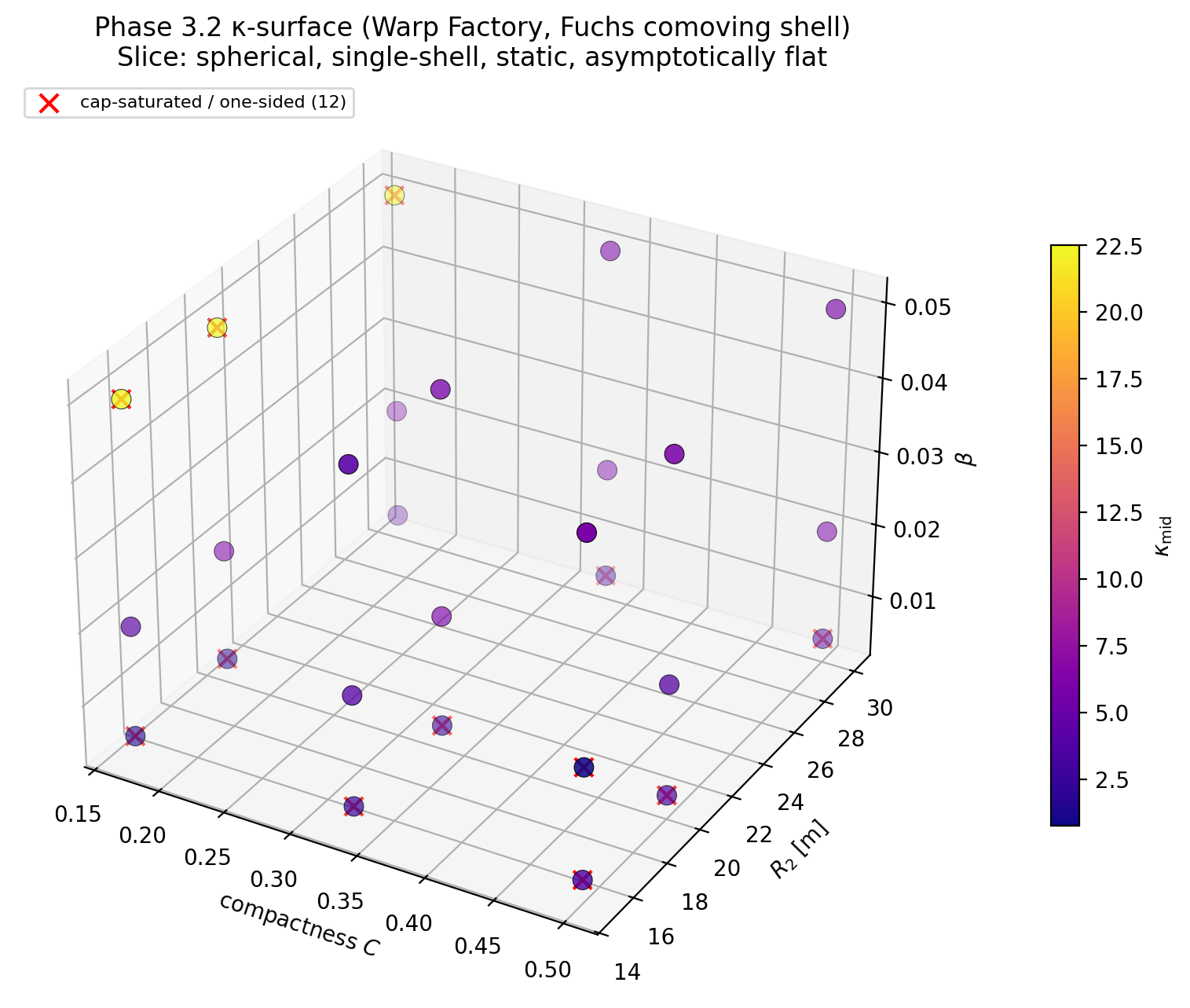
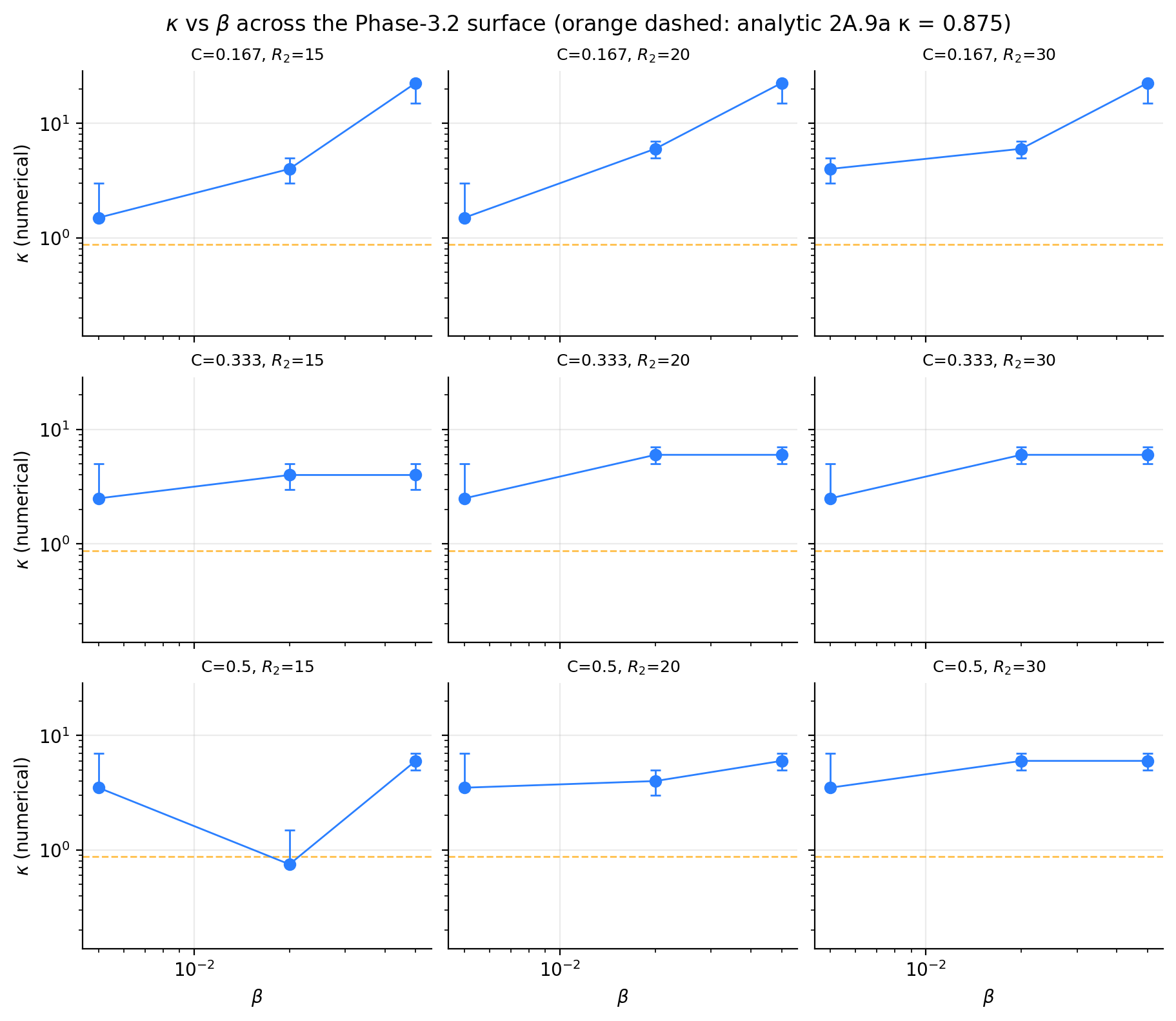
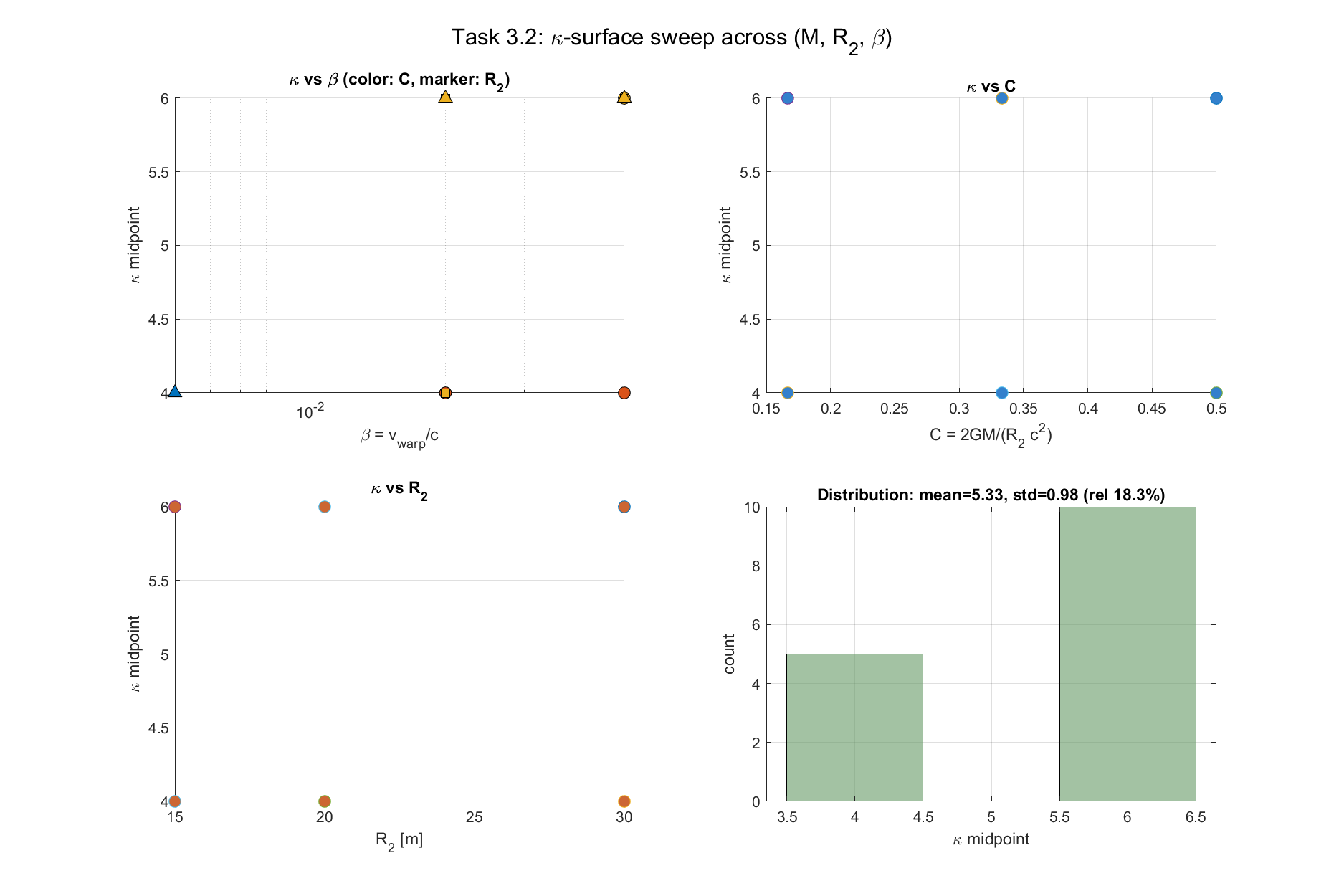
warp_factory_repro/kappa_surface_sweep.m direct render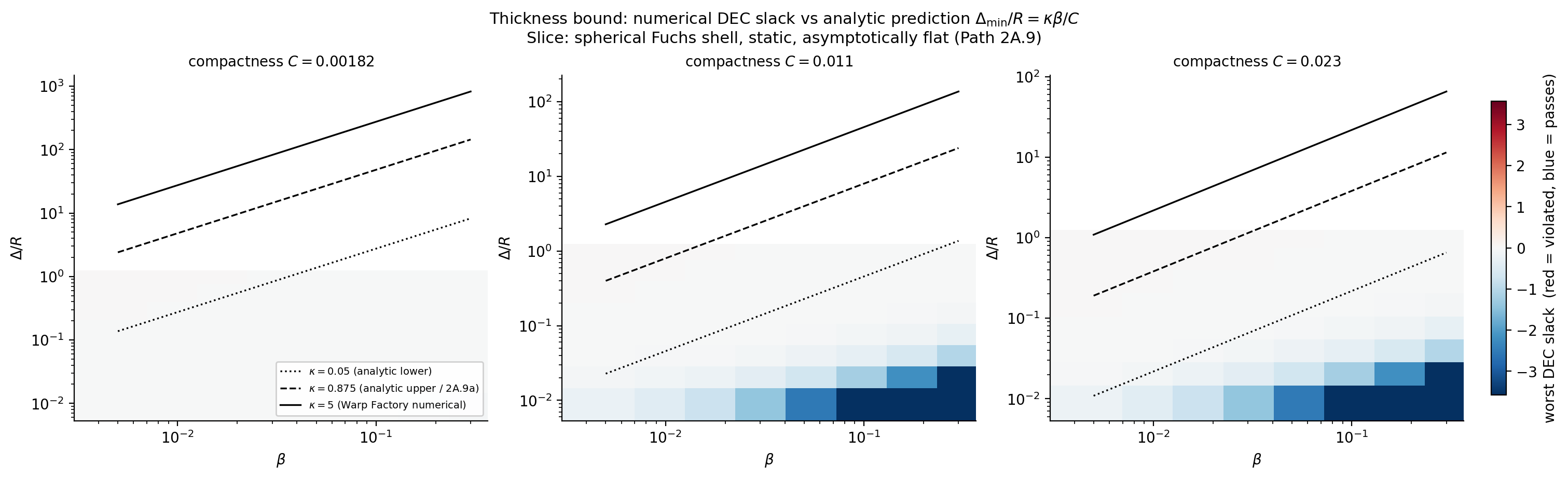
thickness_bound.ipynb 600-cell preview sweep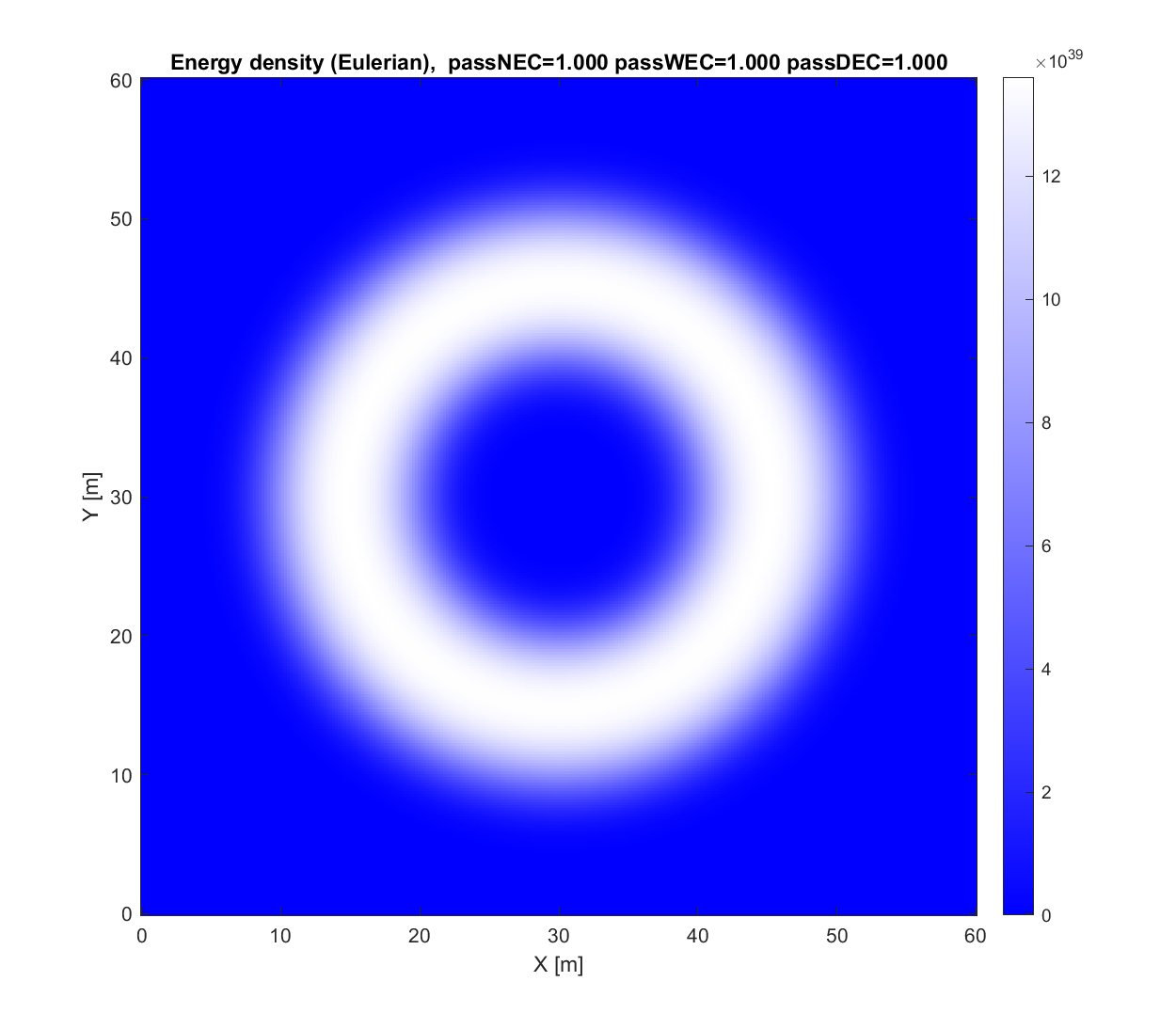
See all 39 figures grouped by topic on the Figures index (Phase 3 section).
| What | Where |
|---|---|
| κ-surface sweep — full per-cell results (27 × 6 × 4) | warp_factory_repro/kappa_surface_sweep.mat |
| κ-surface sweep — flat CSV table | warp_factory_repro/kappa_surface_sweep.csv |
| κ-surface sweep — 4-panel diagnostic figure (κ vs β, κ vs C, κ vs R₂, κ histogram) | kappa_surface_sweep.png |
| Fuchs Fig. 10 reproduction — energy tensor + four EC arrays | fuchs_repro.mat |
| Fuchs Fig. 10 reproduction — slice plots | fuchs_repro_{rho,nec,wec,dec,sec}.png |
| κ-bracket sweep (single-cell, 7 Δ samples) | kappa_sweep.mat |
| Headless console logs | kappa_surface_sweep.log · alcubierre_sanity.log |
| MATLAB scripts | warp_factory_repro/ |
| Notes (sessions 18-19, full table, dispositions) | WARP_FACTORY_NOTES.md |
| Clean-room Python port (metrics, solvers, EC evaluators, certified radial oracle) | warp_factory_py/ |
| Ground-truth adjudicator (radial 0.0% vs Cartesian 9.1→94.0%) | verification/test_prongB_groundtruth.py |
| Certified Δ-ladder re-run (Session-41 κ re-base) | verification/test_delta_ladder_radial.py |
| Certified minimal-mass map — 3-gate battery + full parquet | verification/test_mmin_map_gate.py · sweeps/mmin_map_full_concat.parquet |
| Two-body / graded-wall maps + adjudicators (Sessions 47–48 floor re-base) | verification/test_mmin_nested_map.py · verification/test_mmin_graded_map.py · sweeps/mmin_map_nested_full_concat.parquet |