The Phase 2A no-go is conditioned on five assumptions: (i) Alcubierre βxx̂ shift, (ii) spherical Fuchs-class shell topology, (iii) asymptotically flat vacuum exterior, (iv) steady-state metric, (v) standard 4D General Relativity. Phase 2C tests each one (plus a sixth on quantum-inequality loosening) by relaxing it independently and re-running the energy-condition pipeline. The diagnostic of interest is whether any point in the relaxed parameter space achieves WEC ≥ 0.999 (essentially-strict pass).
| # | Slice / what it relaxes | Sweep size | Best WEC pass | Strict-pass count | Notebook |
|---|---|---|---|---|---|
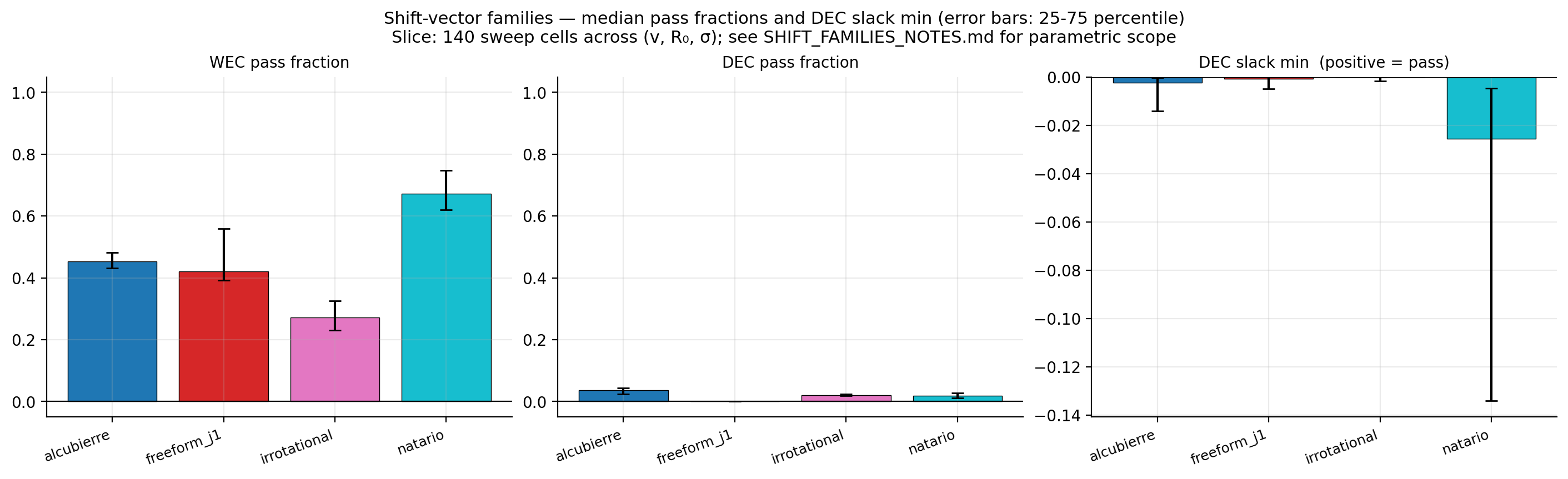
| 1 | Alternate single-mode shifts (Alcubierre · Natário · Rodal-irrotational · free-form j₁) | 140 + 2496 pts | analytic ≤ 0 | 0 (identity) | shift_families |
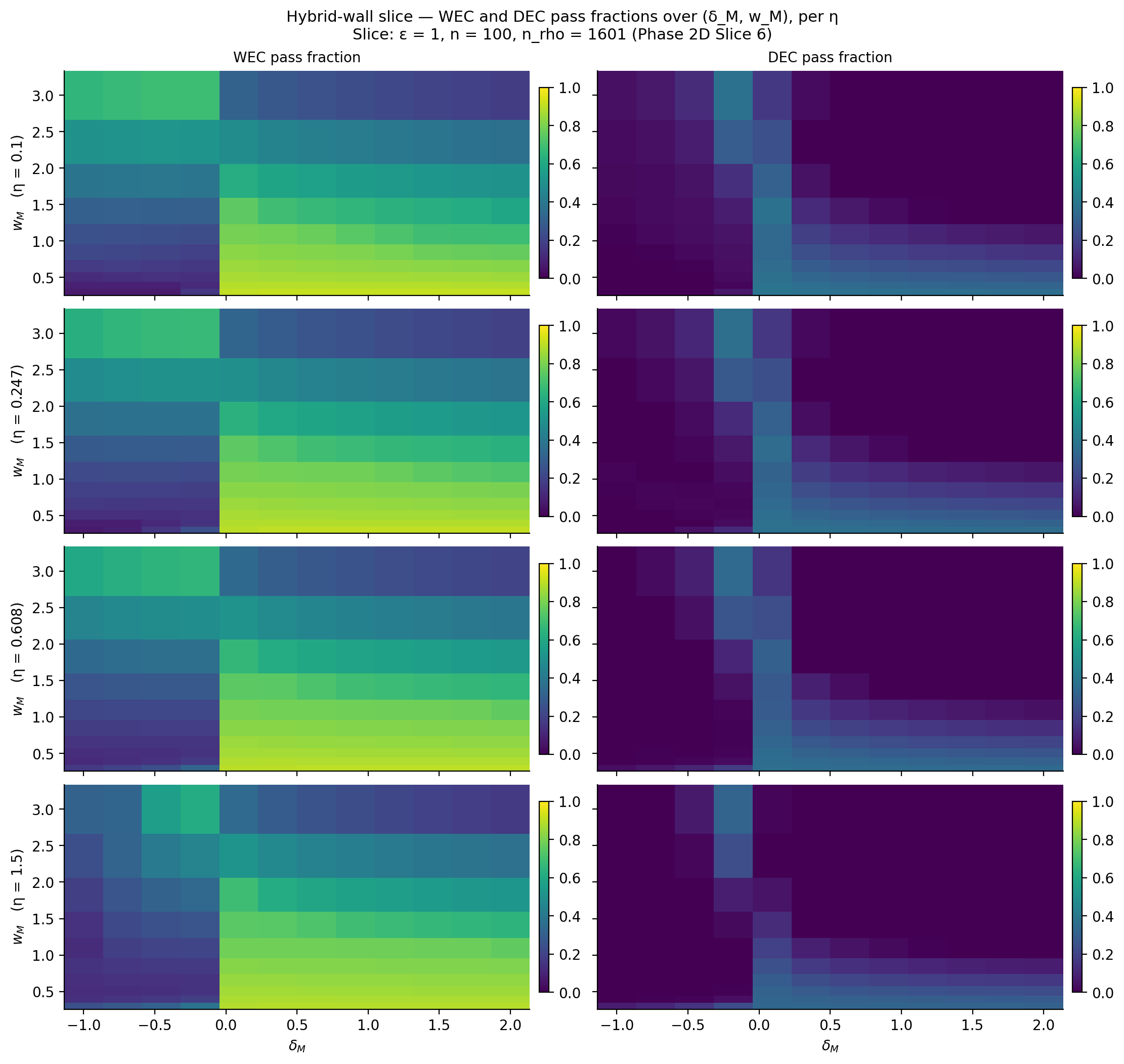
| 2 | Hybrid Fuchs + Krasnikov wall (Krasnikov tube wrapped in matter perturbation) | 480 + 82,944 pts | 0.94 (η ≥ 0.1) | 0 / 34,560 | hybrid_wall |
| 3 | Time-dependent v(t) — drop steady-state assumption | analytic | — | Quadrupole-order zero | time_dependent |
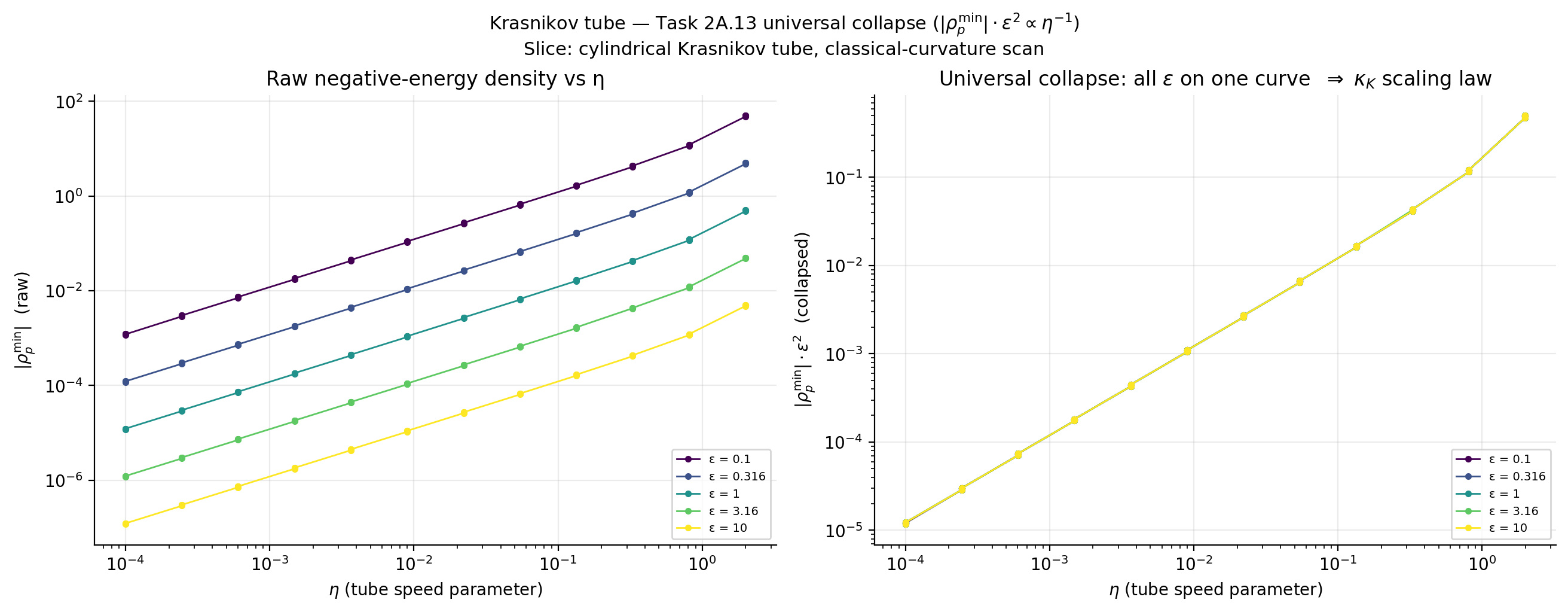
| 4 | Krasnikov-2003 quantum-inequality loosening (drop QI bound) | analytic | — | Our 2A.13 no-go is QI-independent | krasnikov_tube |
| 5 | Cosmological exterior (drop asymptotic flatness — McVittie embedding; + Garattini–Zatrimaylov 2025 EC qualifier, reproduced S46) | analytic | — | Δv ≤ 5.7 × 10⁻³⁶ m/s; G–Z bubble = comoving void | cosmological_exterior |
| 6 | Modified gravity (drop standard 4D GR — f(R), scalar-tensor, Jordan frame) | 161 + LP | 0 | f(R) corner CLOSED (S51–52) | MODIFIED_GRAVITY_LIT.md |
Strict-pass criterion: WEC pass-fraction ≥ 0.999 across the full $(r, \theta)$ grid (Slices 1, 2). Slices 3-6 use slice-specific diagnostics noted in the body sections below.
Session-36 correction: the original Session-9 evaluator carried a frame-projection bug (its recorded observable was coordinate −Ttt, not the Eulerian ρE), so the numeric table originally published here was superseded. The corrected result is stronger — analytic, profile-independent closures for all four families:
| Family | Closure | Identity |
|---|---|---|
| Alcubierre & free-form j₁ (any z-shift β = b(r)ẑ, incl. radial multi-mode) | never WEC | ρE = −b′²sin²θ/32π ≤ 0 |
| Natário (zero-expansion, any profile) | never WEC | ∇·β ≡ 0 ⟹ ρE = −KijKij/16π ≤ 0 |
| Irrotational (Rodal 2025; any potential) | only trivially | ∫ρE dV = 0 ⟹ WEC-everywhere ⟹ ρE ≡ 0 |
Corrected sweeps concur: 0/140 preview points and 0/2496 full-config points achieve WEC ≥ 0.999 on the true ρE. The Path-2A no-go therefore narrows from "Alcubierre shift" to "single-mode axisymmetric shift + spherical fluid-shell source + asymptotically flat vacuum exterior + steady-state metric" — at identity level within the slice.
This narrowing is what drove Phase 2D: the Fell–Heisenberg ansatz violates the "single-mode" assumption (multi-mode; note its concrete form is still axisymmetric about z — the m, n asymmetry is fore-aft), and was the only place in the project where strict-pass solutions existed — until the Session-42 closed-form far-field analysis showed those strict-pass classifications were evaluation-box artifacts (WEC+DEC violations at finite R* outside the box for every tested a > 0; see the Fell–Heisenberg page).
Session-56 upgrade: Natário 2002 itself (gr-qc/0110086) was reproduced exactly — the paper's warp family is precisely this table's "natario" row under f = (1−fAlc)/2, so the Natário closure above is Theorem 1.7's WEC branch instantiated: Natário had the class-level statement in 2002, and our identity is its independent confirmation. The adjudication also sharpened it: WEC violated at 100% of wall points including the axis, dominantly Hawking–Ellis Type IV, with an off-axis ergo-band from v* ≈ 0.18. See NATARIO2002_EVALUATION.md.
Sources: shift_families.ipynb, SHIFT_FAMILIES_NOTES.md (§Session-36 correction), adjudication harness verification/test_shift_families_frame_adjudication.py, corrected sweep parquets sweeps/shift_families_20260705T*.parquet.
Embed the Krasnikov-tube wall inside a single Gaussian matter perturbation parameterised by amplitude $A$, location $\rho_0$, and width $\sigma$. Sweep 480 $(A, \rho_0, \sigma, \eta, \epsilon)$ points; record the in-wall WEC pass fraction.
Result: 0/480 strict-pass in the original preview, strengthened by the Session-40 first full dispatch (82,944 points, all five axes swept including the previously-frozen ε and n): 0/34,560 WEC passes for any tube with η ≥ 0.1, and 0/82,944 DEC passes anywhere (the artifact's only WEC passes sit at η ≤ 0.004, the tube-off trivial limit). The matter perturbation shifts where the negative-energy spike sits but never cancels it. Single-bump matter is not enough; multi-bump and off-wall configurations remain untested but the linear scaling of the negative-energy density with the η lightcone-opening parameter (Slice 4 below) is suggestive that no cancellation is generic.
Sources: hybrid_wall.ipynb, full-sweep parquet sweeps/hybrid_wall_full_concat.parquet.
Drop the steady-state assumption: replace $v_{\rm warp}$ with $v(t)$ and re-derive ADM 4-momentum $P^i(t)$ from a perturbative ramp. The leading time-dependent correction $\Delta\rho$ peaks at 0.3% of the static $\rho_p$ and is antisymmetric in $x$, so its quadrupole moment $Q_{xx}$ vanishes by symmetry. This is the bound on gravitational-wave-recoil momentum injection at quadrupole order.
Higher-multipole channels remain in principle but are bounded by the GW-recoil sweep in Path 2A's acceleration row (≲ 0.25% of vwarp under most-favourable Fuchs-compatible parameters).
Sources: time_dependent.ipynb, TIME_DEPENDENT_NOTES.md.
Krasnikov 2003 (gr-qc/0207057) catalogues three substantive ways the Pfenning–Ford / Ford–Roman quantum inequalities could fail for warp drives: (i) non-isolated systems, (ii) bounded curvature regions where the QI integration kernel under-counts, (iii) non-vacuum quantum states with constrained correlations. The Krasnikov-tube no-go (Phase 2A.13) is built from the classical Einstein equations and is therefore QI-independent: even if all three loopholes are real and the QI bounds are abandoned entirely, the symbolic Einstein-tensor calculation $\rho_p^{\min} = -\kappa_K(\eta)/\epsilon^2$ still holds, and 0/300 sweep points pass WEC.
The QI loosening therefore does not unblock Path-2A — it only changes which of the QFT-side bounds in Phase 2B might apply. Detailed reading: KRASNIKOV2003_EVALUATION.md.
Sources: krasnikov_tube.ipynb, KRASNIKOV_TUBE_NOTES.md, sweep parquet sweeps/krasnikov_tube_20260416T213051.parquet.
Drop asymptotic flatness: embed the Fuchs shell in a McVittie cosmological exterior so that the shell can in principle exchange ADM momentum with the cosmological fluid (escaping the Path-2A acceleration obstruction). Compute the maximum momentum-exchange rate using realistic ΛCDM parameters and the Fuchs-anchor shell mass.
Result: the maximum velocity gain over a Hubble time is
which is 74 orders of magnitude smaller than any useful warp velocity. The cosmological-exterior loophole is technically real but quantitatively negligible.
The slice's second half — energy-condition obligations (Garattini–Zatrimaylov 2025, reproduced Session 46). Garattini & Zatrimaylov (arXiv:2502.13153) show a warp bubble moving radially at the Hubble velocity in de Sitter background has non-negative Eulerian energy density and satisfies volume-averaged WEC/NEC — a genuine modification of the energy-condition obligations when asymptotic flatness is dropped. Session 46 reproduced the construction exactly (every checked equation at machine precision, including against the full 4D Einstein tensor of the exact time-dependent moving-bubble metric; 9-gate battery verification/test_gz_desitter_reproduction.py) — the first external construction in the project to survive reproduction. The sharpenings: the Hubble-matched bubble is exactly comoving (its interior is a Minkowski patch riding the expansion — zero transport content); the "averaged" conditions are fixed-time volume averages inherited from the background, while ANEC along every wall-crossing null geodesic tested is strictly violated; and the local NEC/WEC/DEC violations are a wall-shape-set multiple of the background vacuum density. The qualifier is real (A-grade within slice) but describes a comoving vacuum void, not a vehicle — no useful-warp loophole.
Sources: cosmological_exterior.ipynb, COSMOLOGICAL_EXTERIOR_NOTES.md, GARATTINI_ZATRIMAYLOV2025_EVALUATION.md.
Drop standard 4D GR: in $f(R)$ and scalar-tensor theories the effective Einstein equations include an extra geometric stress-energy term $T^{\rm geom}_{\mu\nu}$ that can absorb part of the negative-energy requirement. Jordan-frame matter (the matter that couples directly to the metric) can be DEC-respecting even when the Einstein-frame matter (the canonically-normalised stress-energy) is not. This was the survey-era reading (a conditional, interpretation-dependent positive).
Sessions 51–52 replaced the survey with computation, testing the loophole on its own Jordan-frame terms — and it fails for warp geometry. For the fixed quadratic theory $f = R + \alpha R^2$, a 161-point α × geometry map rescues nothing (best improvement 0.036–0.2% on EC-violating walls) and any viable α > 0 strictly degrades every EC-passing configuration. And the reconstruction mode ("choose f cleverly") is killed by a feasibility theorem: on null vectors the Jordan-frame NEC is linear in $(f', f'', f''')$ at each value of $R$, and on the Alcubierre wall 23.4% of sampled points individually admit no coefficient triple — no $f(R)$ with a ghost-free graviton, of any functional form, yields NEC-respecting Jordan matter there. The $\nabla\nabla f'(R)$ terms at a warp wall add energy-condition obligations rather than absorbing them.
Slice-honest scope: quadratic $f$ for the map, arbitrary $f' > 0$ for the theorem; the tested wall classes; static, radial representation. Horndeski, $f(R,T)$, EGB remain untested — the assumption is narrowed, not erased. Detailed record: MODIFIED_GRAVITY_LIT.md §6b.
Slice 1's negative result narrows the load-bearing assumption from "Alcubierre shift" to "single-mode axisymmetric shift" — and that narrowing is the seed of Phase 2D, the only place in the project where strict-pass solutions existed (until the Session-42 far-field re-scope). Slices 2-5 close the obvious classical escape routes (hybrid wall, time-dependence, QI loosening, cosmological coupling) — with Slice 5's one genuine qualifier, the Garattini–Zatrimaylov de Sitter bubble, reproduced exactly in Session 46 and found to be a comoving vacuum void with zero transport content. Slice 6, long the only genuinely undetermined slice, had its f(R) corner computed and closed negative in Sessions 51–52 (α-map + designer-f feasibility theorem; other modified-gravity families still open with criteria). Phase 2C is therefore closed as a phase but contributes the framing for everything downstream.
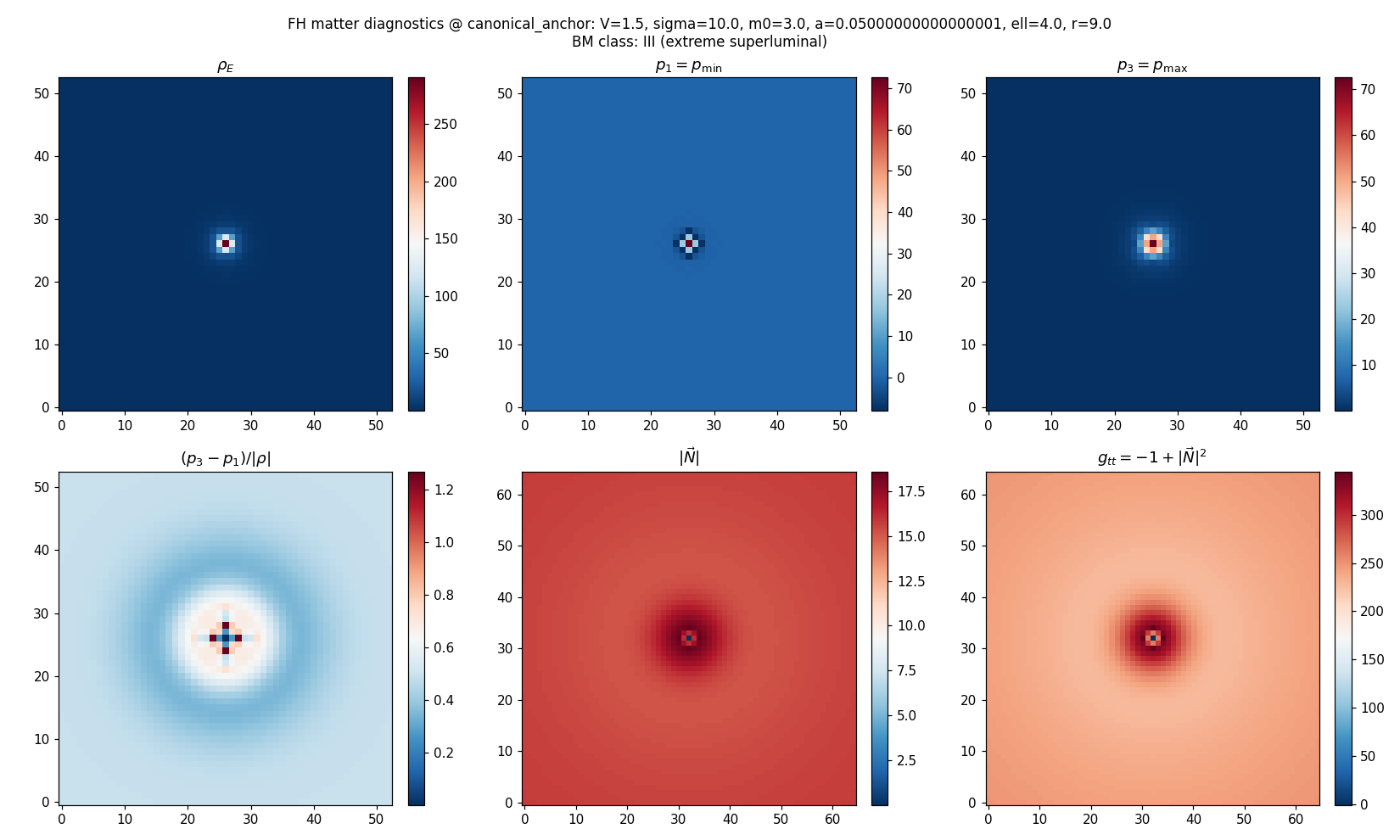
One figure per slice (where the slice is reducible to a single image). Each is generated directly from the underlying parquet sweep.
krasnikov_tube.ipynb 300-cell sweep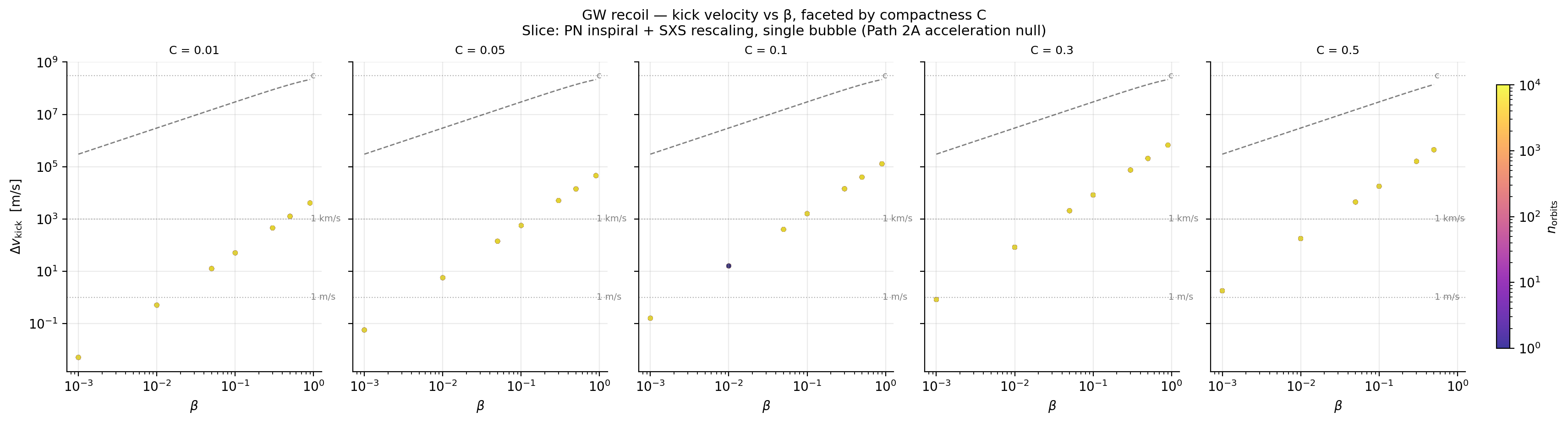
See all 39 figures grouped by topic on the Figures index (Phase 2C section).